

Pygmy Falcon

Polihierax semitorquatus

Thorn savanna. Grey above (female with rufous mantle); white below; red soft parts.
LC
Not Endemic
Pygmy Falcon Newmans Birds

Description

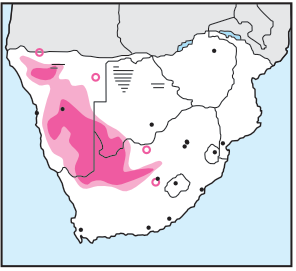
Common resident to arid western region. Identified by very small size and entirely white underparts, the female with a chestnut-brown mantle. In flight, told by speckled wings and white rump. When perched on roadside telephone poles, can easily be mistaken for a shrike owing to its small size. A species of the dry west. Pairs usually seen perched on thorn trees (Camelthorn tree) or baobabs in open grassy areas, often close to the communal nests of the [Sociable Weaver] or, less commonly, [Red-billed Buffalo-Weaver], with which it shares the nest chamber and whose distribution it is linked with. Call is a high pitched ‘Kik kik kik’ often while bobbing tail and head. Hunts from a perch, mainly on lizards and skinks, large insects, small rodents and nestlings sometimes those of its nest hosts. 40- 75 g.

Quick Facts

size

Size

19.5 cm - M

behaviour

Names

A: Dwergvalk
Ss: Phakwana
G: Zwergfalke

Bird Family

Small raptors characterised by pointed wings and, usually, prominent ‘sideburns'. Females are larger than males. Falcons are aerial hunters, typically seizing smaller birds in a rapid dive from above. Characteristic calls are high-pitched ‘kek-kek-kek-kek' sounds, uttered when agitated. Kestrels are small falcons that eat insects caught in the air with their feet, or small mammals and reptiles caught on the ground. Their flight is more leisurely than that of true falcons.


Grey
Savanna Bushveld

Distribution

Gallery

Pygmy Falcon Newmans Birds
behaviour

Behaviour

Breeding

Breeding

Habitat

Habitat

behaviour

Best Locations

0 Cart