

Little Sparrowhawk

Accipiter minullus

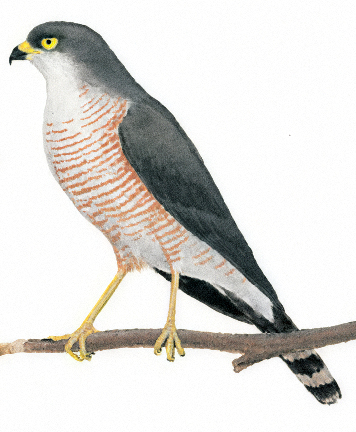
Woodland. Above grey; tail black with two white spots; below banded rufous; soft parts yellow.
Goshawks, Sparrowhawks
LC
Not Endemic
Little Sparrowhawk AI

Description

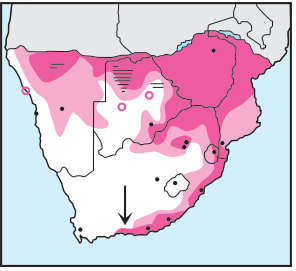
Fairly common resident, very small sized Accipiter. Adult identified by very small size, yellow eyes (eye can be more red in Br. season) and eye ring, slender yellow legs and yellow cere. In flight, from above, two conspicuous white spots on upper tail close to white tail covert. Flight from below, finely barred body and pale rufous flanks and distinctive barred undertail. Similar to [Shikra] and larger [African Goshawk]. Immature recognised by heavy spotting on the underparts and brown upper parts. Call is a single-syllabled ‘ki’ rapidly repeated to sound like a small car’s engine which is having trouble starting. Occurs singly in densely wooded situations, forest fringes, riverine forest, woodland, wooded valleys and stands of exotic trees. Secretive but bold, hunting on the wing. Feeds on birds and small lizards. 70-90 g.

Quick Facts

size

Size

23-25 cm - M

behaviour

Names

A: Kleinsperwer
Z: uMqwayini
Ss: Fiolo E Nnyenyane
G: Zwergsperber

Bird Family

True hawks, characterised by their secretive nature. They have slender bodies, short, rounded wings, long tails, small, sharp bills and long, bare, often slender legs and toes. They catch their prey (usually small birds) in a low, rapid aerial pursuit from the cover of a leafy tree. Females are larger than males.


Grey
Savanna Bushveld

Distribution

Gallery

Little Sparrowhawk AI
behaviour

Behaviour

Breeding

Breeding

Habitat

Habitat

Occurs singly in densely wooded situations, 'forest' fringes, riverine 'forest', woodland, wooded valleys and stands of exotic trees.


behaviour

Best Locations

0 Cart