

Kori Bustard

Ardeotis kori

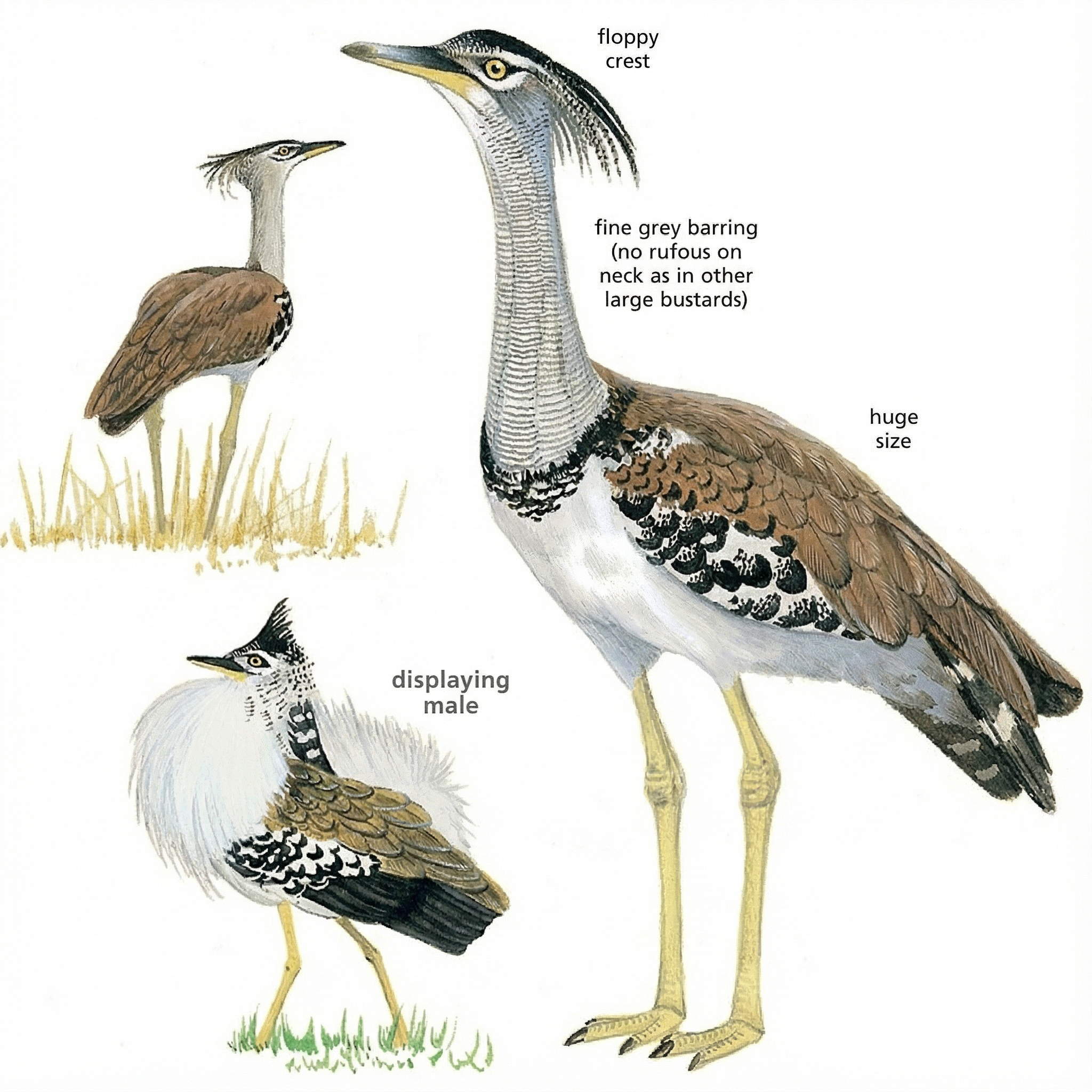
Woodland and grasslands. Back and wings light brown; coverts with black-and-white markings; head with crest at rear; neck grey; below white; legs pale yellow.
Bustards, Korhaans
NT
Not Endemic
Kori Bustard Newman's Birds

Description

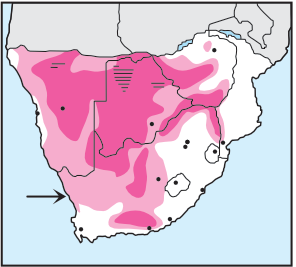
Common resident. Identified by huge size and crested head; only likely to be confused with [Ludwig’s Bustard] and [Denham’s Bustard]. Sexes are alike, but male is about 20 per cent larger than female. Walks slowly with measured strides and flies reluctantly. In courtship the male calls a deep ‘wum, wum, wum, wum, wummmmm’. Male also performs an elaborate courtship display: the throat-pouch is inflated and the frontal neck-feathers splayed outwards revealing their white bases; the head with raised crest is drawn back; the wings are drooped and the tail deflected upwards and forwards to the neck with the white undertail coverts splayed outwards conspicuously (see illustration of male in partial display). Occurs singly, in pairs or in groups in open woodland, bushveld and semi-arid grassland in the Karoo and Namibia.

Quick Facts

size

Size

134 cm - VL

behaviour

Names

A: Gompou
Z: umNgqithi
Ss: Kgori
G: Riesentrappe

Bird Family

Large, long-legged, long-necked terrestrial birds, cryptically coloured, with short tails and feet having three forward-facing toes. Most have elaborate courtship displays involving plumage transformations, flights or unusual calls. The smaller species are called korhaans locally.


Black & White
Savanna Bushveld

Distribution

Gallery

behaviour

Behaviour

Breeding

Breeding

Habitat

Habitat

Occurs singly, in pairs or in groups in open woodland, bushveld and semi-arid 'grassland' in the 'Karoo' and Namibia.


behaviour

Best Locations

0 Cart