

Three-banded Courser

Rhinoptilus cinctus

Dry woodland. The white throat has a chestnut V-shaped collar; the upper breast has a dark brown breast-band extending to the shoulders, and a chestnut lower breast-band.
LC
Not Endemic
Three banded Courser Newman's Birds

Description

Uncommon visitor and resident. Darker than [Double-banded Courser] with bold head markings and bands spanning the upper breast (not encircling the neck). Yellow base to bill; yellow eye-ring and legs also diagnostic. Immature has lower band poorly defined. Mainly nocturnal, and calls mostly at night, ‘chick-a-chuck-a-chuck-a-chuck’. Occurs singly or in pairs in well-grassed woodland and thornveld of the drier regions. When approached it freezes, usually with its back to the observer.

Quick Facts

size

Size

28 cm - M

behaviour

Names

A: Driebanddrawwertjie
Ss: Mokopjwane Wa Metjhatoraro
G: Bindenrennvogel

Bird Family

Pratincoles are migratory and nomadic birds with very short legs in relation to the length of their bodies. At rest or in their elegant, often erratic flight they resemble terns. They feed mostly in the air, in flocks. Their calls are of a ‘kip-kip-kip…' nature. The related coursers are more lapwing-like with erect stance, but unlike plovers lack a hind toe; they are terrestrial feeders. Sexes are alike in both groups.


Collars & Breast Bands
Savanna Bushveld

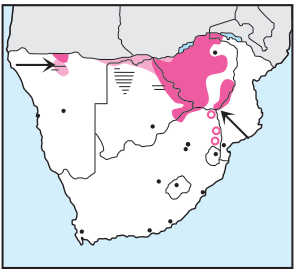
Distribution

Gallery

Three banded Courser Newman's Birds
behaviour

Behaviour

Breeding

Breeding

Habitat

Habitat

Occurs singly or in pairs in well-grassed woodland and thornveld of the drier regions.

behaviour

Best Locations

0 Cart