
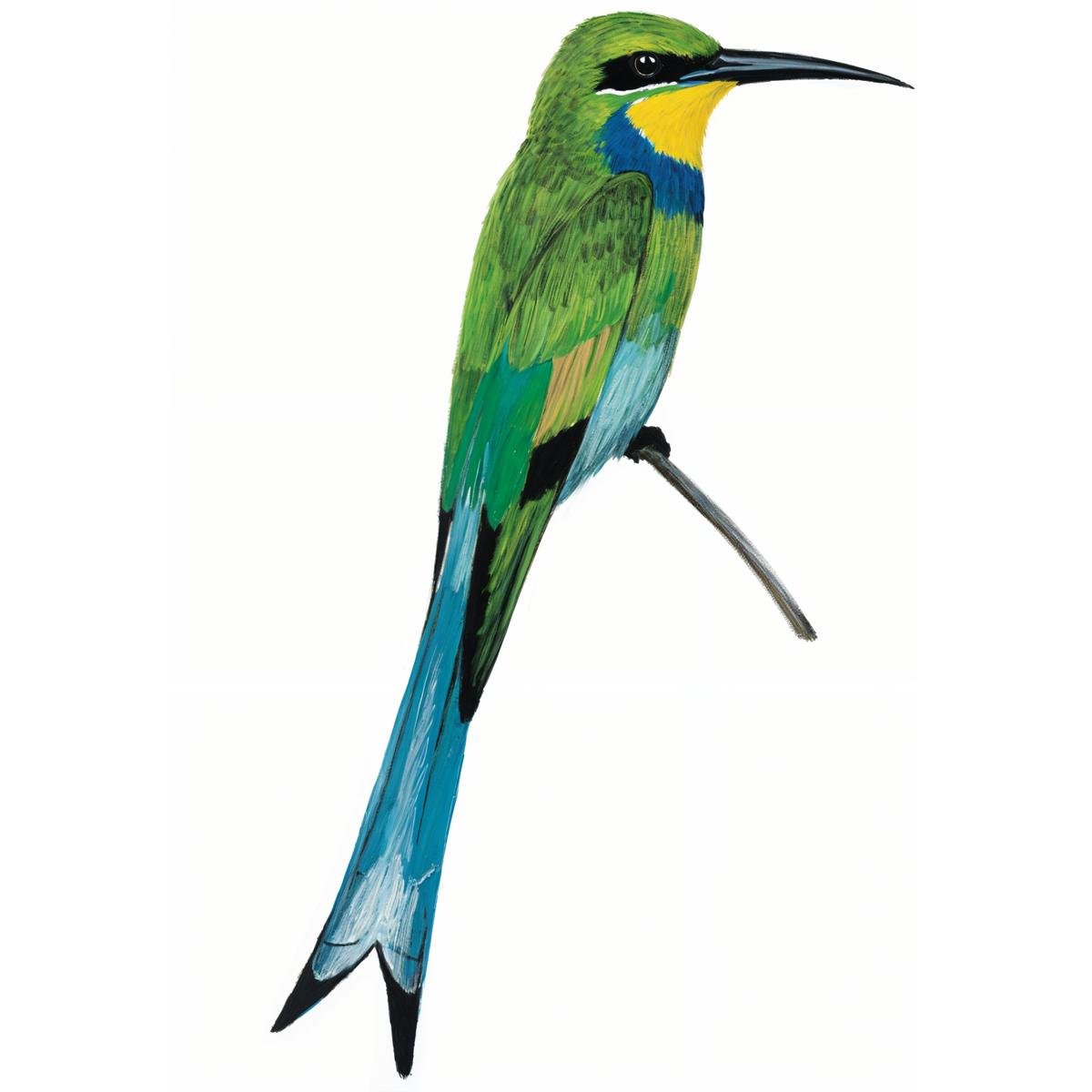


Swallow-tailed Bee-eater

Merops hirundineus

Western savanna. Green above and upper breast; throat yellow with blue band; belly and forked tail blue. Immature apple-green above and below.
LC
Not Endemic
Swallow tailed Beeeater Newman's Birds

Description

Common resident. A small, fork-tailed bee-eater told from Little Bee-eater by bright blue collar and bluish underparts and tail. Immature lacks the yellow and blue throat; underparts pale apple-green. The call is a soft ‘kwit kwit’. Flocks occur in a variety of woodland habitats, being especially common in the regions of Kalahari sands. Hawks from a perch, often near pans and dry river beds. Nomadic when not breeding.

Quick Facts

size

Size

20-22 cm - M

behaviour

Names

A: Swaelstertbyvreter
Ss: Thlapolome Ya Setonolekabelane
G: Schwalbenschwanzspint Gabelschwanzspint

Bird Family

Colourful, aerial-feeding birds with long decurved bills, many with elongated tail-feathers (absent in immatures). Most occur in flocks, catching flying insects while twisting and turning in graceful aerial manoeuvres or by hawking them from a perch in short aerial sallies, usually returning to the same perch to eat their prey. Immatures are dull versions of the adults. Sexes are alike.


Collars & Breast Bands
Savanna Bushveld

Distribution

Gallery

Swallow tailed Beeeater Newman's Birds
behaviour

Behaviour

Breeding

Breeding

Habitat

Habitat

Flocks occur in a variety of woodland habitats, being especially common in the regions of Kalahari sands.


behaviour

Best Locations

0 Cart