


Spotted Eagle-Owl

Bubo africanus

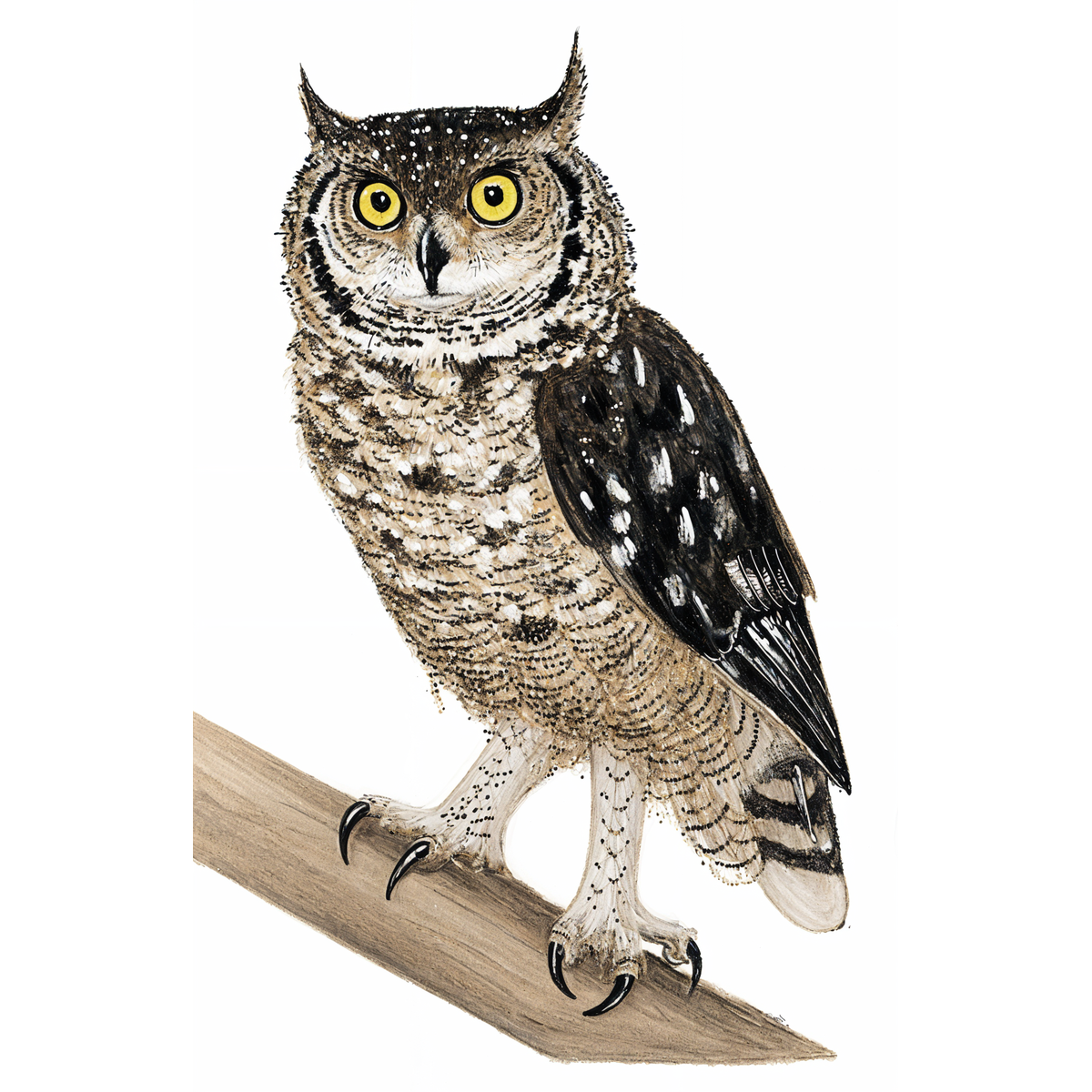
Widespread. Dark brown above with ­prominent ‘ear’ tufts; dark border to facial disc; below finely barred and blotched with dark brown, white and buff; eyes yellow.
Owls
LC
Not Endemic
Spotted Eagle Owl Newman's Birds

Description

Very common resident. A fairly large grey-brown owl, easily confused with [Cape Eagle-Owl]. Differs in smaller size, pale yellow eyes, lightly blotched underparts with fine barring and smaller feet and talons. A rufous morph with orange-yellow eyes also occurs, though less commonly; this told from [Cape Eagle-Owl] by fine barring on underparts. Male calls ‘hu-hooo’, female ‘hu-hu-hooo’, the sound rising on the second syllable. Usually occurs in pairs in a wide range of habitats including bushveld and suburbia, where it perches on buildings and street lights or feeds on lawns at night. Large exotic trees and rocky hillsides are also much favoured. The most common large owl across the subregion.

Quick Facts

size

Size

43-50 cm - L

behaviour

Names

A: Gevlekte Ooruil
Z: isiKhovamponjwama
Ss: Sehihi
G: Fleckenuhu, Berguhu

Bird Family

Nocturnal, erect-standing birds of prey characterised by large, rounded heads, large forward-facing eyes set in a flattened face and feathered legs (except for Pel's Fishing-Owl). Some have feather adornments on their heads that resemble ears, but they are not used for hearing. Immatures are usually darker and fluffier than adults.


Speckled
Savanna Bushveld

Distribution

Gallery

Spotted Eagle Owl Newman's Birds
behaviour

Behaviour

Breeding

Breeding

Habitat

Habitat

Usually occurs in pairs in a wide range of habitats including bushveld and suburbia, where it perches on buildings and street lights or feeds on lawns at night. Large exotic trees and rocky hillsides are also much favoured.


behaviour

Best Locations

0 Cart