Shikra (Little Banded Goshawk)

Accipiter badius

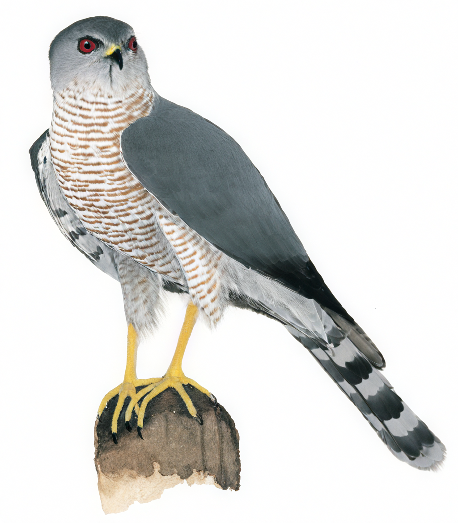
Woodland. Banded rufous below chin to belly; above grey. Immature has rufous streaks and bands below.
Goshawks, Sparrowhawks
LC
Not Endemic
Shikra Newman's Birds

Description

Fairly common resident. Adult identified by rufous-banded underparts that extend to the throat, red eyes (no eye ring), yellow legs, yellow cere cf. [African Goshawk] . In flight, from above, by plain grey upper parts, lacking any white on rump and upper tail. May sometimes show small white spots on the mantle. Immature differs from immature of [Little Sparrowhawk] in eyes and legs being more orange-yellow, and broad reddish-brown streaks and banding on the underparts; and from immature of [Gabar Goshawk] in dark cap, lack of white rump, and different eye and leg colour. Call is a metallic, two-syllabled ‘kli-vit’ repeated, also a plaintive ‘tee-uuu’. Occurs singly in a wide range of woodland types, even in semi-arid regions. Less secretive than other small Accipiter hawks, frequently perching in the open, even on posts. Feeds mainly on reptiles, small birds and rodents. 100 – 270 gr.

Quick Facts

size

Size

30-34 cm - M

behaviour

Names

A: Gebande Sperwer
Z: uheshomidwayidwa
Ss: Fiolo Ya Motjhato
G: Schikra

Bird Family

True hawks, characterised by their secretive nature. They have slender bodies, short, rounded wings, long tails, small, sharp bills and long, bare, often slender legs and toes. They catch their prey (usually small birds) in a low, rapid aerial pursuit from the cover of a leafy tree. Females are larger than males.


Rufous
Savanna Bushveld

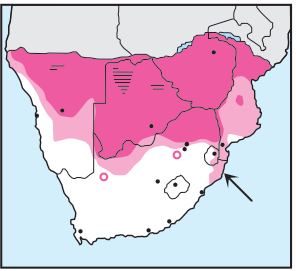
Distribution

Gallery

Shikra Newman's Birds
behaviour

Behaviour

Breeding

Breeding

Habitat

Habitat

Occurs singly in a wide range of woodland types, even in semi-arid regions.

behaviour

Best Locations

0 Cart