
Red-breasted Swallow

Cecropis semirufa

Grass savanna. Above metallic blue; below deep orange.
Swallows
LC
Not Endemic
Red breasted Swallow AI

Description

Common summer resident. Identified by large size, blue cap extending to below the eyes and entirely orange-chestnut underparts. In flight differs from [Mosque Swallow] in buff (not white) underwing coverts and longer tail-shafts. Immature duller above and much paler about the cheeks, chin and throat. Also, outer tail-feathers are shorter. Differs from [Mosque Swallow] in having the dark cap extending below the eyes and onto the ear coverts. Adults utter a soft warbling and a strident trill. Pairs occur in summer near their nest sites: road culverts, low causeways (not over water) and aardvark holes in open savanna and grassland. Flight is low and slow with much leisurely gliding.

Quick Facts

size

Size

24 cm - M

behaviour

Names

A: Rooiborsswael
Z: iNkonjanesifubabomvu
Ss: Lekabelane-Petakgubedu
G: Rotbauchschwalbe

Bird Family

Small, long-winged, aerial-feeding birds. Swallows have mostly glossy-blue upperparts (some with rufous caps) and whitish, rufous or streaked underparts; the blackish saw-wing swallows are an exception. Saw-wings have rough, saw-like leading edges to their primary feathers (not apparent in the field). In all species, immatures are duller than adults. They build nests with mud pellets or burrow tunnels in banks or cliffs; they drink and bathe in flight by skimming the surface of still water, and perch to rest. For comparison, see swifts.

Blue
Aerial

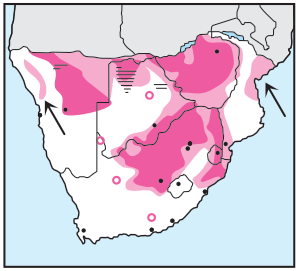
Distribution

Gallery

Red breasted Swallow AI
behaviour

Behaviour

Breeding

Breeding

Habitat

Habitat

Pairs occur in summer near their nest sites: road culverts, low causeways (not over water) and aardvark holes in open 'savanna' and 'grassland'.


behaviour

Best Locations

0 Cart