

Monteiro’s Hornbill

Tockus monteiri

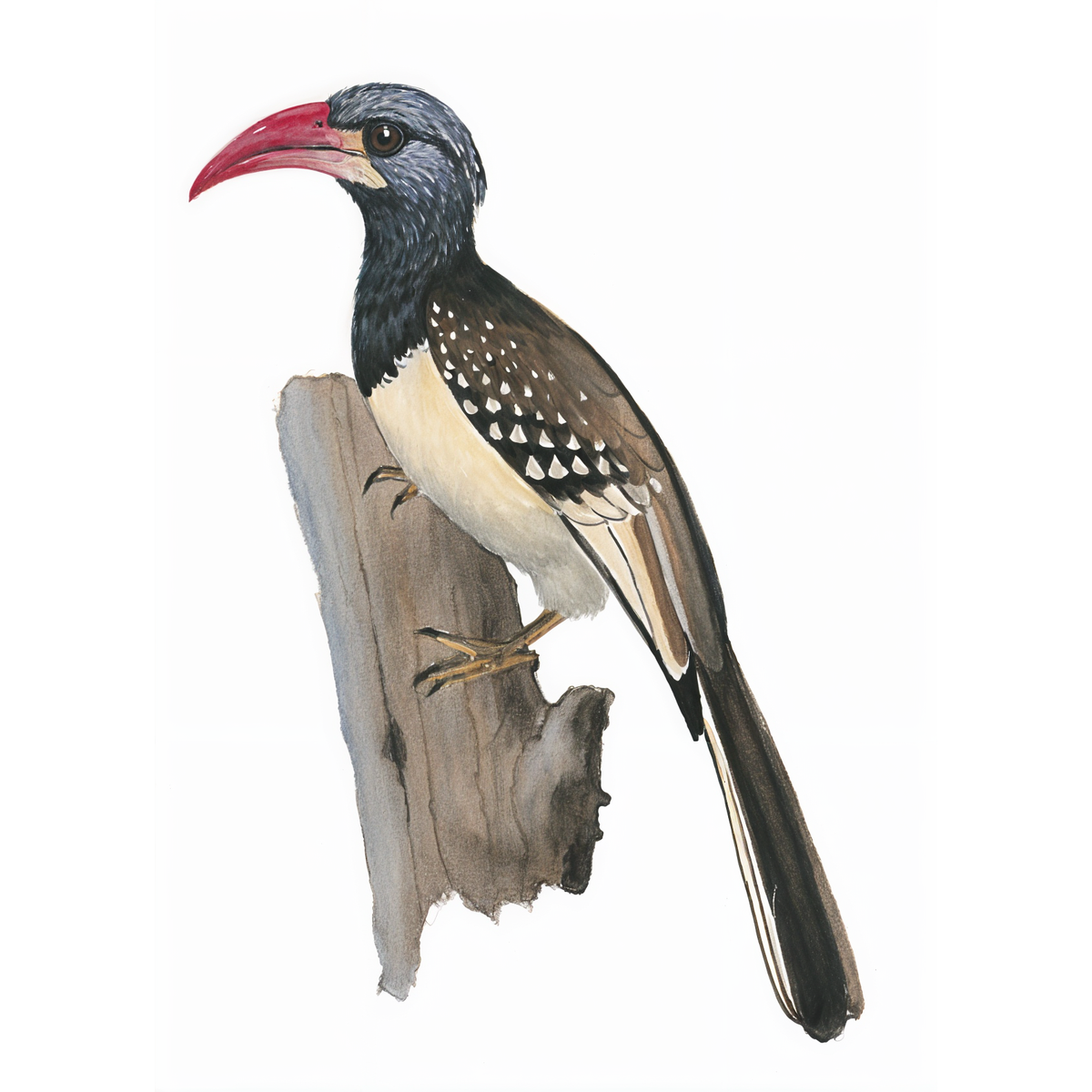
Rocky regions. Above dark brown to breast; wings with white spots; secondaries and outer tail feathers white; lower breast to vent white; bill red.
Hornbills
LC
Near Endemic
Monteiro s Hornbill Newman's birds

Description

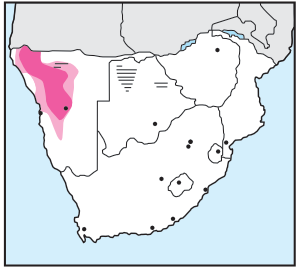
Fairly common, near-endemic resident. It differs from [Bradfield’s Hornbill] in having white spotting on the upper wing coverts and entirely white outer tail-feathers. Also, when seen in flight, shows entirely white secondary wing-feathers, forming a pale panel. Female’s facial skin and eye-rings are blue. The call when displaying is a hoarse ‘tu-aack tu-aack’, while its territorial call is ‘kok kok kok kokok kokok kokok…’ rising in volume. Usually seen singly or in pairs in rocky regions (where it breeds) and in dry woodland in northern Namibia, feeding mostly on the ground.

Quick Facts

size

Size

54-58 cm - L

behaviour

Names

A: Monteironeushoringvoël
Ss: Korwe Ya Lepheosweu
G: Monteirotoko

Bird Family

Insectivorous and frugivorous birds with large, decurved bills, sometimes with a horny casque on the upper mandible. Arboreal or terrestrial feeders, or both, they nest in holes in trees (among rocks in a few species) and, in most species, the female seals herself in during incubation. Their flight is heavy and undulating with periods of gliding.


Dark Brown
Savanna Bushveld

Distribution

Gallery

Monteiro s Hornbill Newman's birds
behaviour

Behaviour

Breeding

Breeding

Habitat

Habitat

behaviour

Best Locations

0 Cart