
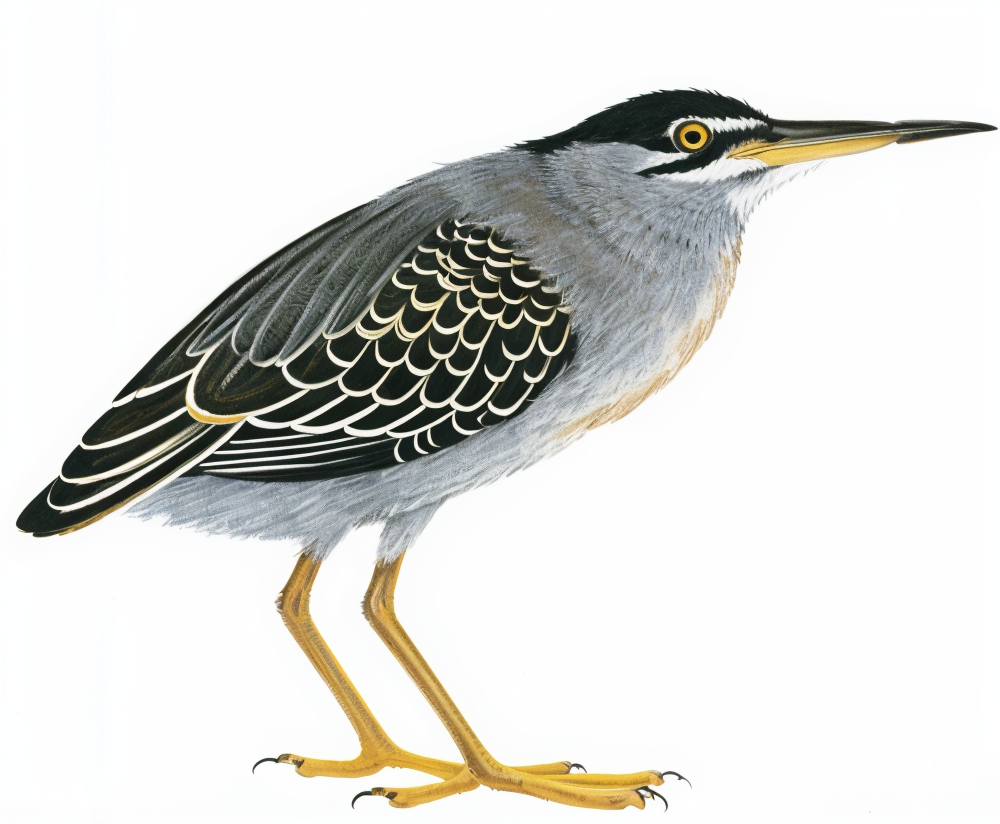


Green-backed (Striated) Heron

Butorides striata

Inland waters. Mantle and underbody grey; black cap; dark wings and tail; legs orange.
Bitterns, Egrets, Herons
LC
Not Endemic
Stiated Heron AI

Description

Common resident. Its upper parts appear grey-green, with creamy feather edges. Sides of neck and flanks grey, cap black; yellow feet prominent on take-off. Immature identified by dark upper parts with whitish spots on folded wings; cf. immature of [Dwarf Bittern] and [Little Bittern]. When flushed, gives a sharp and startling ‘kew’! A common small heron, usually found singly on well-wooded rivers, large dams, pans, estuaries and lagoons with mangroves. Active by day, hunting from a low branch or dead tree in water or on shoreline. Perches in a tree when flushed. Not as secretive as the bitterns, often standing in exposed positions.

Quick Facts

size

Size

41 cm - L

behaviour

Names

A: Groenrugreier
Z: umacutholuhlaza
Ss: Kokolofitwe Ya Mokokotlotala

Bird Family

Water-associated birds with long bills and necks and long legs. When breeding, many species have long, filamentous plumes on their back or lower breast (or both), while others have more or less permanent long plumes on their napes. In flight, they tuck their heads into their shoulders, thus differing from storks, ibises and cranes. They seldom soar. Many herons are solitary in habit and secretive; others are gregarious and seen more frequently. Most perch in trees and nest in trees or reeds, or even on the ground. All have harsh, squawking voices heard mostly when flushed. Four comparative silhouettes represent (a): Dwarf Bittern; (b): Squacco Heron; (c): Little Egret; and (d): Grey Heron.


Grey
Wetlands

Distribution

Gallery

Stiated Heron AI
behaviour

Behaviour

Breeding

Breeding

Habitat

Habitat

A common small heron, usually found singly on well-wooded rivers, large dams, pans, estuaries and lagoons with mangroves.


behaviour

Best Locations

0 Cart