
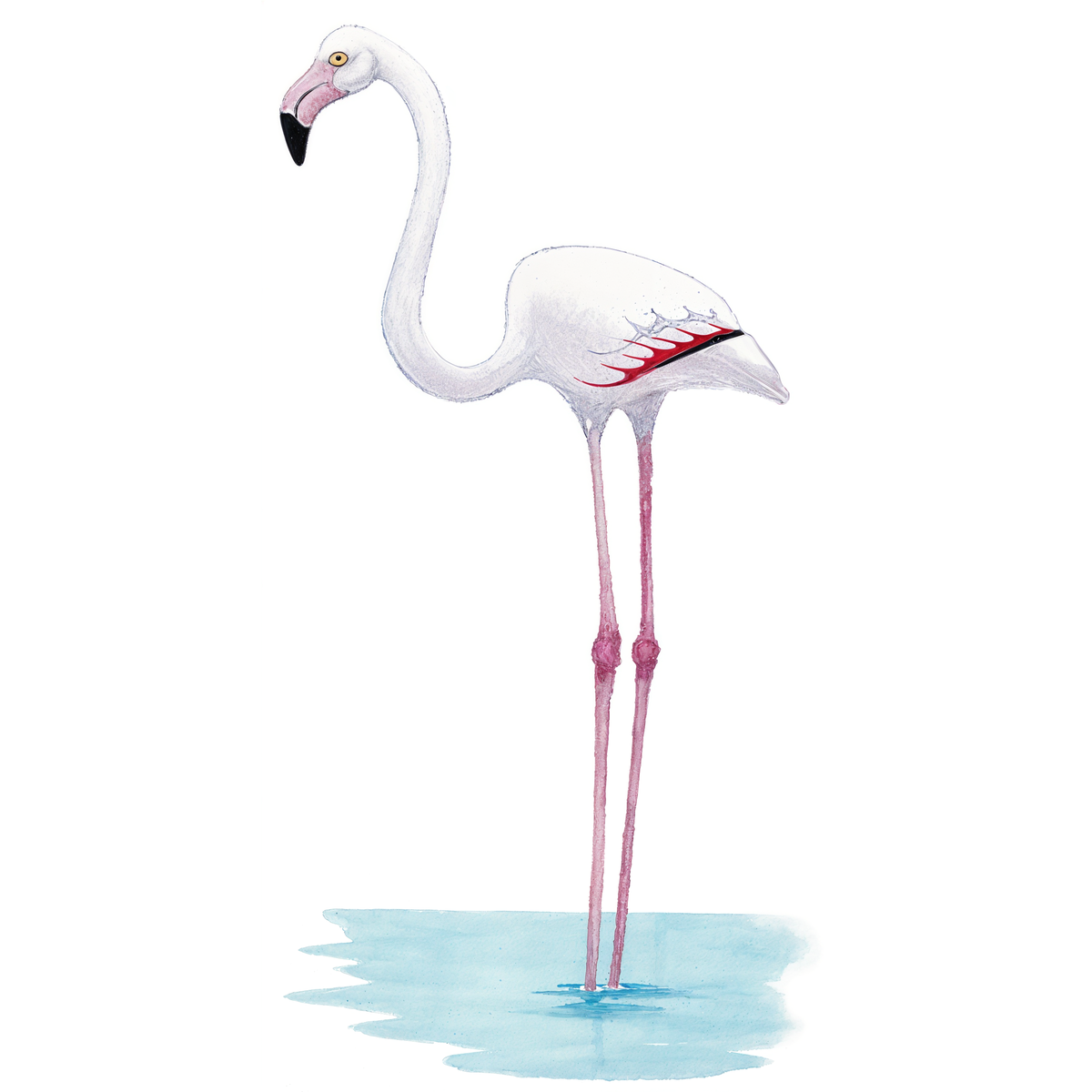


Greater Flamingo

Phoenicopterus roseus

Salt pans and soda lakes. White with pink and black bill; long pink legs; red and black wings.
Flamingos
NT
Not Endemic
Flamingo AI

Description

Locally abundant nomadic resident and visitor from other parts of Africa. Distinguished by pink bill (not dark maroon as [Lesser Flamingo]) with black tip. Prefers shallow lakes, deep brackish water, saltpans and coastal lagoons. May be in company of [Lesser Flamingo] and can be told apart in being much taller and whiter. In flight, the wing coverts are a uniform scarlet. Immaturegrey and black, with blue-grey bill. Feeds on brine crustacea and molluscs by filtering bottom sediment that is stirred up by its feet, its head is often submerged as a result.

Quick Facts

size

Size

140 cm - VL

behaviour

Names

A: Grootflamink
Z: ukholwasomkhulu
Ss: Mmamolalana e moholo
G: Flamingo

Bird Family

Occur in flocks of many thousands or singly. The two species described below may be found together. They prefer shallow saline pans, dams and estuaries, as well as sheltered coastal bays, but are nomadic and remain in one place only for as long as conditions are suitable. Over most of the region they are infrequently seen. Both species have a honking call which, in flocks, sounds like babbling. Immatures are grey-brown with a bill pattern similar to that of adults. They feed on algae or aquatic invertebrates which are filtered from the water with specialised bills, the feeding birds walking in a characteristic posture with the head held upside down.


White
Wetlands

Distribution

Gallery

Flamingo AI
behaviour

Behaviour

Breeding

Breeding

Habitat

Habitat

Prefers shallow lakes, deep brackish water, saltpans and coastal lagoons.

behaviour

Best Locations

0 Cart