


Double-banded Courser

Rhinoptilus africanus

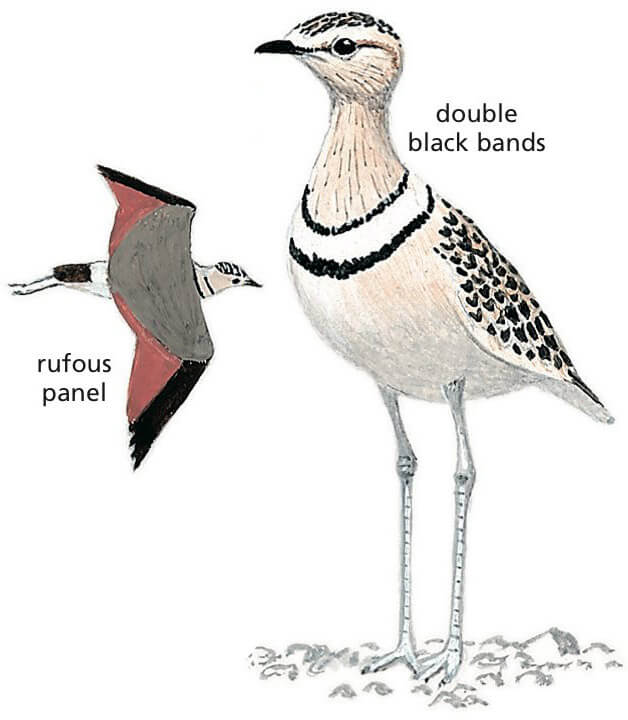
Dry grasslands. Two narrow black breast-bands on white underparts.
LC
Not Endemic
Double-banded Courser

Description

Common resident. A distinctive, pale courser with two black bands encircling the lower neck and upper breast. Immature is similar. In flight reveals striking rufous panels on its upper wings. Normally silent but may call ‘pee-wee’ if put to flight; also calls ‘chik-kee, chik-kee, chik-kee-kee-kee-kee’ while flying at night. Occurs in pairs or scattered groups in arid grassland or semi-desert and on fringes of dry pans and barren, stony flats. Active day and night and seemingly indifferent to hot conditions. Runs rather than flies. Nomadic.

Quick Facts

size

Size

22 cm - M

behaviour

Names

A: Dubbelbanddrawwertjie
Ss: Mokopjwane Wa Metjhatobedi
G: Doppelband-Rennvogel

Bird Family

Pratincoles are migratory and nomadic birds with very short legs in relation to the length of their bodies. At rest or in their elegant, often erratic flight they resemble terns. They feed mostly in the air, in flocks. Their calls are of a ‘kip-kip-kip…' nature. The related coursers are more lapwing-like with erect stance, but unlike plovers lack a hind toe; they are terrestrial feeders. Sexes are alike in both groups.


Collars & Breast Bands
Nama Karoo

Distribution

Gallery

Double-banded Courser
behaviour

Behaviour

Breeding

Breeding

Habitat

Habitat

Occurs in pairs or scattered groups in arid 'grassland' or semi-'desert' and on fringes of dry pans and barren, stony flats.


behaviour

Best Locations

0 Cart