
Black-bellied Bustard

Lissotis melanogaster

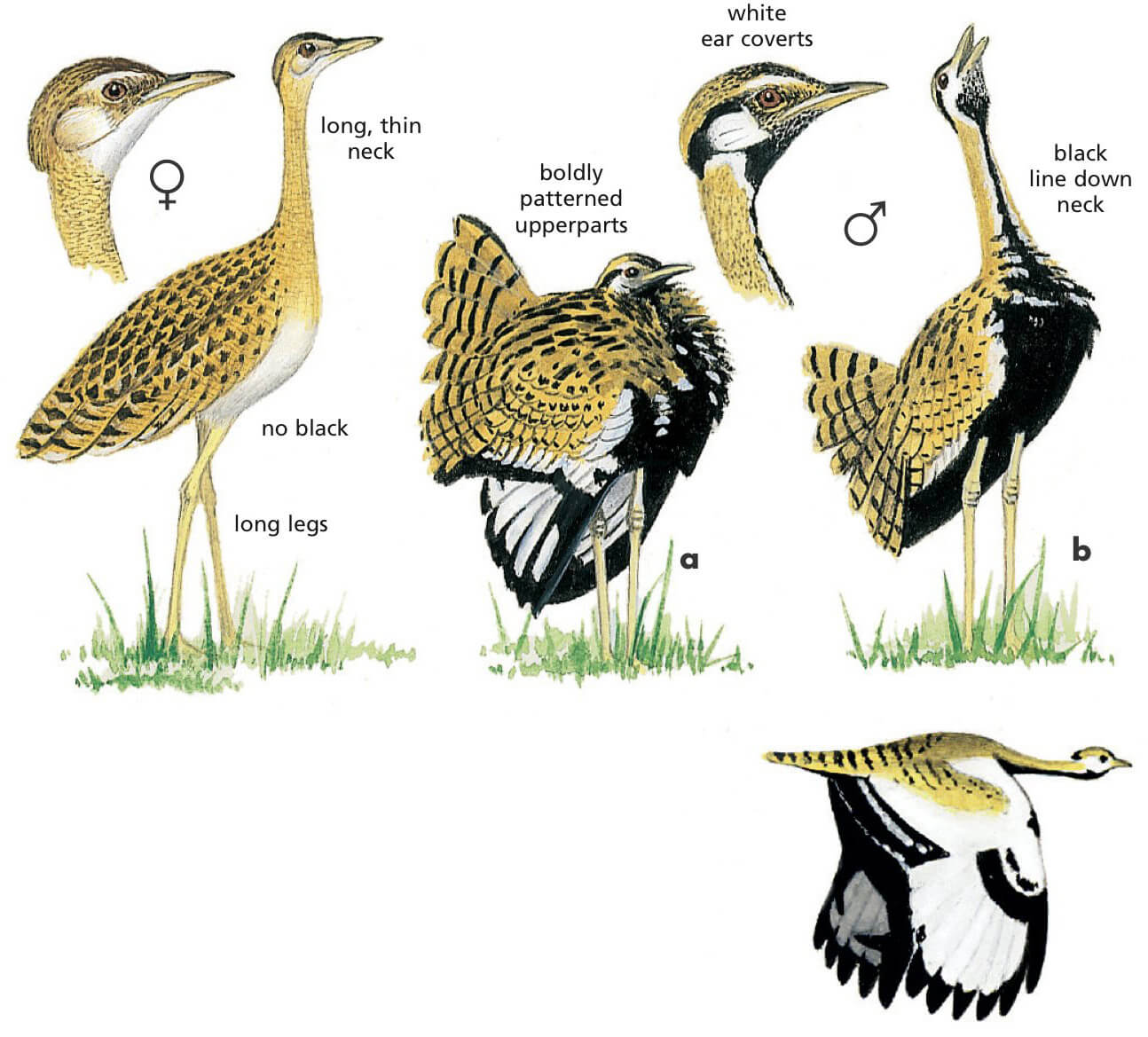
Grasslands. Tawny above and on neck with black markings; male has black-and-white head marking plus black belly; female white below; legs pale yellow.
Bustards, Korhaans
LC
Not Endemic
Black-bellied Bustard

Description

Common resident. Characterised by long legs (proportionately longer than any other korhaan). Male in flight shows white upper wings. The underwings are black except for a prominent white patch at the base of the primaries. Male has entirely black underparts, extending in a line up the front of the neck to the chin. Female has white underparts cf. female White-bellied Bustard. Male calls while posturing as follows: the head and neck are withdrawn and wings drooped (a); the head and neck are then fully stretched upwards while the bird utters a dull ‘waak’ or ‘phwoe’ (b); the head is then lowered about halfway to the body and the bird utters a throaty grunt followed by a five-second pause; then it utters a sharp, whip-like sound ‘ooor-whip’. During courtship the male performs an aerial display in which the white upper wings are strikingly presented. Found singly or in pairs in rank, moist grassland.

Quick Facts

size

Size

58-65 cm - L

behaviour

Names

A: Langbeenkorhaan
Z: uFumba
Ss: Lekakarane La Mpantsho
G: Schwarzbauchtrappe

Bird Family

Large, long-legged, long-necked terrestrial birds, cryptically coloured, with short tails and feet having three forward-facing toes. Most have elaborate courtship displays involving plumage transformations, flights or unusual calls. The smaller species are called korhaans locally.


Black & White
Grasslands

Distribution

Gallery

behaviour

Behaviour

Breeding

Breeding

Habitat

Habitat

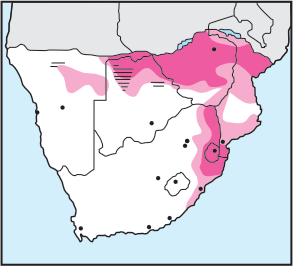
Found singly or in pairs in rank, moist 'grassland'.

behaviour

Best Locations

0 Cart