
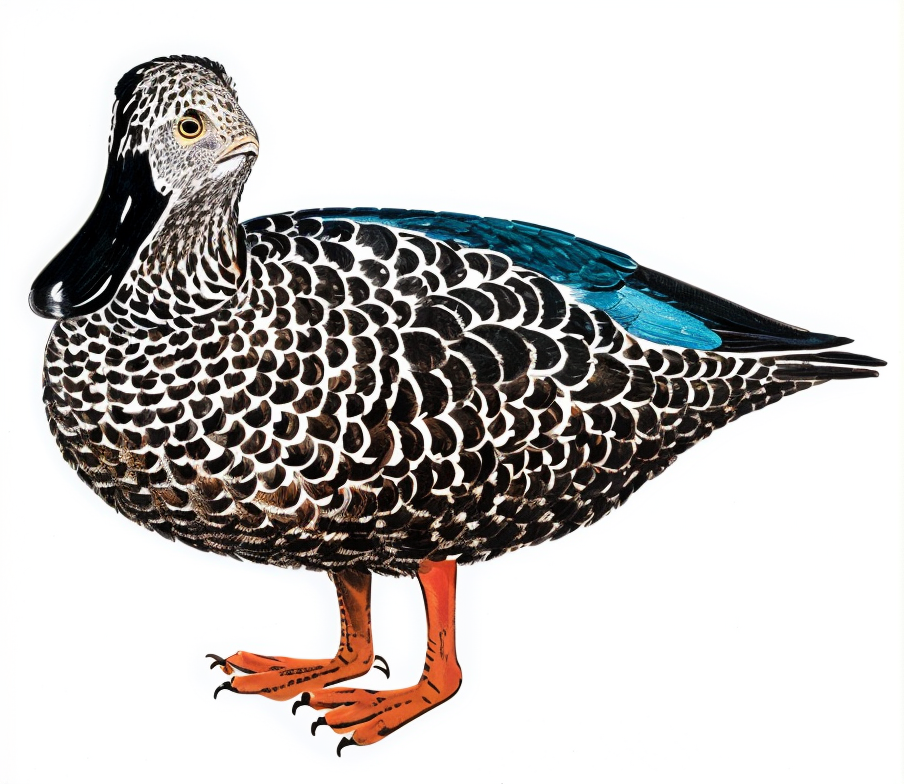


Cape Shoveler

Spatula smithii

Wetlands. Large drab duck. Black, broad-tipped bill; orange-yellow legs; speckled all over dark brown on pale grey. Male has paler head. In flight, shows pale blue-green on upper wings.
Ducks, Geese
LC
Near Endemic
Cape Shovler AI

Description

Common near-endemic resident. A dull brownish duck identified by large black spatulate bill and yellow-orange legs; cf. [Northern Shoveler]. In flight shows a dark green speculum and pale blue forewings. Male has yellow eye; eye dark in female. Immature is duller. Normally silent but male sometimes utters an explosive ‘rrar’ or a series of quiet, hoarse ‘cawick’ sounds with rising pitch, sometimes interspersed with a fast, rattling ‘ra-ra-ra-ra-ra’. Female may utter a series of notes with downward inflection, a rippling chatter ‘cha-cha-cha-cha-cha’ or a persistent quacking. Pairs or flocks in shallows of tidal estuaries, lagoons and sewage ponds; indifferent to large open waters. Most common in the southwestern Cape and southeastern region of southern Africa, moving between the two regions.

Quick Facts

size

Size

53 cm - L

behaviour

Names

A: Kaapse Slopeend
Z: unofosholo
Ss: Letatakgaba La Borwa
G: Kaplöffelente

Bird Family

Most of the region's ducks are either migratory to some extent or locally nomadic, their movements being dictated by food, rainfall and breeding requirements. Many show marked plumage differences between the sexes. Ducks and geese undergo a flightless four-to-eight-week period each year when they moult all their flight feathers simultaneously. The large Spur-winged and Egyptian Geese differ from geese of the northern hemisphere in having longer bills and legs, the African Pygmy-Goose being our only representative of the ‘true' geese. Ducks of the genus *Dendrocygna* (whistling ducks), which include the White-faced and Fulvous whistling ducks, differ from those of other genera in having close-set legs placed well back on the body. This enables them to stand erect and walk without waddling. In addition they show no sexual dimorphism and have whistling voices. In contrast, ducks of the genus *Anas*, often referred to as dabbling ducks, have widely spaced legs placed centrally on the body. This causes them to stand with the body horizontally and to walk with a waddle. They are further typified by quacking voices.


Speckled
Wetlands

Distribution

Gallery

Cape Shovler AI
behaviour

Behaviour

Breeding

Breeding

Habitat

Habitat

behaviour

Best Locations

0 Cart